
IOX-Zeroᴱ
Development of systems for the emission-free chemical tempering of container glass using ion exchange
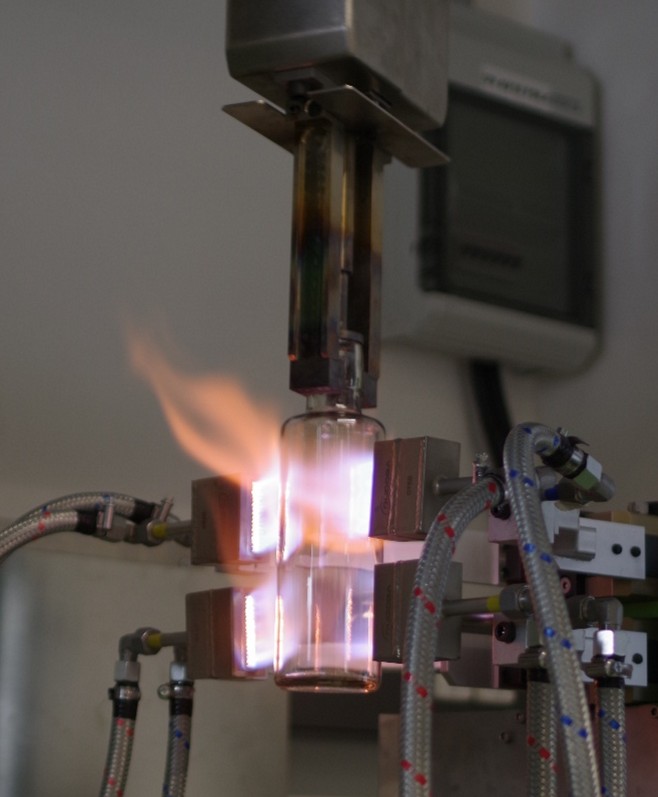
Stressing glass using ion exchange has been a well-established method for display glass for many years, with the aim of making the glass more break-resistant. In this diffusion-driven process, ions near the glass surface are exchanged for larger ions. The incorporated ions stress the glass near the surface, creating a zone of residual compressive stress that makes the glass more resilient. The process is robust and reliable, but it is time-consuming and costly due to the long leaching time. By additionally conditioning the bottles with natural gas burners, the process time can be reduced from hours to just a few minutes. However, this treatment step increases energy consumption and CO₂ emissions.
To optimize the increased energy and resource consumption, the IOX-ZeroE project aims to develop emission-free heating processes and replace the gas burners. Infrared emitters, plasma burners, and hydrogen burners, among others, are being investigated as CO2-free heat sources for the process. In addition to achieving a sufficient glass surface temperature, the project aims to ensure adaptability to varying product geometries as well as short processing times while maintaining consistent glass quality. Once the most promising heating option has been selected, it will be integrated into an existing demonstration plant.
Another project goal is to prevent the generation of nitrate-containing wastewater, which is produced during conventional chemical tempering. After the ion-exchange process, salt residues must be removed from the glass surface. To this end, a new method will be tested in which a closed-loop process for the nitrate is developed to enable the continuous recycling of the salt back into the process.
If the project is successful, short treatment times, continuous process control, environmentally friendly cleaning, and CO₂-free heat treatment could lead to the establishment of a low-emission, cost-effective ion-exchange-based process for manufacturing shatter-resistant, longer-lasting glass bottles — a process that could find application not only in the premium segment but also in mass markets.
Project Profile
Duration: 01.01.2026 – 30.06.2028
Funding:
- AiF Projekt GmbH
- ZIM cooperation projects
Project Partner: Füller Glastechnologie Vertriebs-GmbH
Contact: Prof.-Dr.-Ing. Thorsten Gerdes, Andreas Rosin, Frank Bayer